MyLife MyWay

Sunday, November 26, 2017

Dyspareunia - Pain During Intercourse


What is dyspareunia?

Dyspareunia means pain during intercourse. It can be caused by a variety of reasons such as local infection, hormonal changes with aging, or an allergy caused by the use of personal care products.

How is it caused?
  • Tipped or retroverted uterus: Some women with a tipped uterus experience pain during intercourse. The penis may hit the cervix or uterus during sex causing pain. This condition is known as collision dyspareunia.
  • Endometriosis: The endometrium, which is the tissue lining the uterus, may grow outside the uterus causing deep pain during sex.
  • Infection: Bacterial or yeast infections may result in pain during intercourse.
  • Vulvodynia:This is a condition in which the vulva becomes sensitive and tender to touch.
  • Drugs: Common drugs used for allergy, high blood pressure or depression may affect the amount of vaginal lubrication, sexual arousal and desire. A dry vagina results in pain during intercourse.
  • Physical problems: An abdominal surgery or a scar during delivery can cause a lot of pain during intercourse.
  • Pelvic floor myalgia: Involuntary contractions of the pelvic muscles can result in difficult and uncomfortable sex.
  • Emotional issues: Sometimes, past experiences such as sexual abuse or other psychological problems can be a cause of pain during sex

 How is it treated?
The treatment options may depend upon the results of the pelvic examination and other diagnostic tests. The various treatment options include: 
  • A changed position in case of a tipped uterus, may allow the uterus to move away resulting in a more comfortable intercourse.
  •  In case of infections medications may be given either orally or as vaginal pessaries.
  •  If the problem is caused by insufficient lubrication of the vagina, a cream or jelly may be used to reduce the pain.
  • Relaxation exercises may help regain control over vaginal muscles. This may help in reducing pain during sexual intercourse. 
  • If the diagnostic tests determine that a tipped uterus or endometriosis may be responsible for the pain, surgery may be suggested.
(Disclaimer: This content including advice provides generic information only. It is in no way a substitute for qualified medical opinion. Always consult a specialist or your own doctor for more information. Blogger does not claim responsibility for this information.)


Low Sperm Count


What is azoospermia?

Azoospermia is the term used to describe a complete absence of sperm in the ejaculate (semen) or the failure of formation of spermatozoa.

What are the causes?

Azoospermia may be due to a number of factors. The three major causes for lack of sperm production are hormonal problems, testicular failure, and varicocoele.
  1. Hormonal problems

    Pituitary hormones stimulate the testes to produce sperm. If these hormones are absent or decreased, the testes will not produce sperm in the optimum numbers. Androgens or steroids, taken either by mouth or by injection for body building, lowers the production of hormones necessary for sperm production. 

  2. Testicular failure

    This generally refers to the inability of the testicle to make adequate numbers of mature sperm. The failure may occur at any stage in sperm production for a number of reasons. The testicle may completely lack specific cells (the seminiferous epithelium) that divide to become sperm or the sperm may not be able to complete their development. The latter may be caused by genetic abnormalities, hormonal factors, or varicocoeles. 

  3. Varicocoele

    Varicocoeles are dilated veins in the scrotum (comparable to a varicose veins in the leg), which become dilated, and blood does not drain properly. This allows extra blood to pool in the scrotum, which has a negative effect on sperm production. This condition is the most common reversible cause of male infertility and may be corrected by surgery.

How is it diagnosed?

uring the physical examination, the doctor may check the size and consistency of the testicles. The doctor may also measure levels of follicle stimulating hormone (FSH) and testosterone hormones.

Chromosomal evaluations and testing for Y-chromosome abnormalities can reveal a genetic basis for the absence of sperm. This may be the case in up to 10 percent of men with azoospermia.

An examination of the scrotum and epididymis may reveal signs of scarring from an old infection or congenital absence of the vas deferens (CAVD), the tube that connects the testicle to the ejaculatory ducts. CAVD is not all that rare; it is frequently seen in men who carry the cystic fibrosis (CF) genetic abnormality but do not have the disease. 

A rectal examination determines whether there is prostate tenderness, which may imply scarring and blockage of the ejaculatory stream. If the ejaculate volume is low, the doctor will perform an ultrasound examination to look for a complete obstruction of the ejaculatory ducts. Finally, a biopsy of the testicle may indicate normal sperm production and confirm the diagnosis of blockage in the epididymis, vas deferens or ejaculatory ducts.

What is the treatment?

After a thorough evaluation is made, the doctor can determine whether hormone treatment (rarely beneficial), microsurgical correction of a blockage, or retrieval of sperm for in vitro fertilization and intracytoplasmic sperm injection (IVF-ICSI) might offer the possibility of success. 

ICSI is an acronym for Intracytoplasmic Sperm Injection. It is a form of Assisted Reproductive Technique wherein under high magnification the sperm is introduced within the cytoplasm of the egg. ICSI involves injection of a single sperm in to single egg in order to get fertilization. If there has been failure of IVF more than twice, those having low sperm count with low motility, and azoospermia, ICSI can be attempted with sperm collected surgically.

Most men facing semen analysis fear the diagnosis of azoospermia. They should be aware that the diagnosis does not necessarily mean that the testes produce no sperm or can never be made to produce sperm and that they will never have a biological child. Accurately diagnosing azoospermia is a complicated process, but one that is clearly necessary before treatment begins.


(Disclaimer: This content including advice provides generic information only. It is in no way a substitute for qualified medical opinion. Always consult a specialist or your own doctor for more information. Blogger does not claim responsibility for this information.)

PREMATURE EJACULATION

What is premature ejaculation?

Premature ejaculation is the inability to delay ejaculation till the man wishes or when ejaculation occurs too early in the sexual act to satisfy both partners. The time to reach the stage of ejaculation is subjective and varies form one man to another. Some men may ejaculate immediately after copulation begins while another may not ejaculate even after 10 minutes. Thus, time is not a criterion for ascertaining whether the ejaculation is premature or not; mutual satisfaction is the benchmark against which this condition is measured. 


What is the cause?


Premature ejaculation primarily has a physiological basis. Biologically, men have an orgasm approximately 2-3 minutes after penetrating the vagina. Women, on the other hand, typically take more time to reach the climax. Since in most cases, the partners may not climax together, they are not satisfied and the ejaculation is termed premature. 

However, premature ejaculation may be caused by a variety of psychological and social reasons. It is seen that it occurs frequently when the man is under mental stress or anxiety. Anxiety may be due to the fear of non-performance, the fear of being discovered (as during premarital or extramarital sex in our society) or anxiety related to contraction of sexually transmitted diseases or an unwanted pregnancy. 

Though men of all ages may experience the condition, it is more common in adolescents, young adults and inexperienced men. However, it is also true that almost all men experience it at some point in their lives. Premature ejaculation is one of the most common sexual problems for which couples seek advice. The result of treatment is often successful.

What are the symptoms?

Since premature ejaculation is not a disease, it does not have the classic "symptoms". An individual realizes that he is suffering from it when sexual intercourse ends before either partner is completely satisfied. It is diagnosed by a physical examination, in addition to interviews with the couple regarding their relationship. 

What is the treatment?

In some cases, the problem can be solved simply by educating an individual about the condition and reassuring him. Counselling is provided by psychologists that helps a man to deal with his fears and anxieties and, thus, eliminate the psychological causes of the condition. The following techniques may be beneficial in delaying ejaculation:

  1. The "stop and start" method – in this method, the man learns to recognise the stage after which he cannot control ejaculation. The treatment method trains the person to remove the stimulus just before that stage is reached so that the urge to ejaculate is controlled. For example, when during masturbation, the man reaches a point just before ejaculating, he stops the stimulus until he starts losing the erection. Once the stage is past, he can resume the activity. This process is repeated again and again until the individual is able to delay ejaculation till the time he wishes. This method called the 'Masters and Johnson method', is most effective when the help of the partner is sought during actual intercourse.
  2. The squeeze technique – in this method, the partner gently squeezes the tip or base of the penis just before the point of ejaculation thereby "cancelling" the orgasm. This process can be continued until the couple decides mutually to reach the climax.
  3. Desensitising creams and gels are available in the market that reduce the sensitivity of the penis and help men reach climax later. Some men also feel that condoms reduce the sensations and, in addition to providing safer sex, help them last longer.
  4. The couple can also experiment with sexual positions as some positions offer more control than others and may help to delay ejaculation.

Are You Sexually Incompatible?

Sexual health is an important part of your physical and mental health as well as your emotional and social well-being. It's important to take care of your sexual health and to talk about sex and relationships with your loved ones. Sexual health requires a positive and respectful approach to sexuality and sexual relationships, as well as the possibility of having pleasurable and safe sexual experiences, free of coercion, discrimination and violence. For sexual health to be attained and maintained, the sexual rights of all persons must be respected, protected and fulfilled.


She needs lots of foreplay, while he needs to go for it straightaway. It is one of the common problems faced by couples, and if not tackled with care, this sexual incompatibility inevitably starts affecting relationships at every phase. Look into it before it makes you drift apart!


Are You Sexually Incompatible?
The Mars versus Venus duel often comes to the fore between the sheets. She needs lots of foreplay, while he needs to go for it straightaway. It is one of the common problems faced by couples, and if not tackled with care, this sexual incompatibility inevitably starts affecting relationships at every phase. Also termed discrepant libidos, it has been observed as the most common cause for dissatisfaction in a relationship. 

Reasons for incompatibility
  1. Frequency of Sex: the frequency of sexual desire varies from person to person, so much so that both partners idea of what is right often may not match. The need for frequent sex also depends on the stage in which the relationship is in. The intimacy quotient is at its peak among new lovers. Remember those days when you just couldn't get enough of each other? The passionate phase makes way for the more compassionate love which is more meaningful and satisfying. However, when everyday sex starts fading and one starts hearing more of not tonight honey, dissatisfaction is bound to creep in.
  2. Appetite: each one of us has a different sexual appetite which also varies at different stages of our lives. The partner who has the higher sex drive is most likely to feel rejected and hurt when the desires are not reciprocated. On the other hand, the one with the lower drive can feel pressurised and resentful at having to perform even when he/she doesn't feel up to it.
  3. Experiments: the missionary position works very well among couples in the heydays of their relationship. And then there comes a time when one of the partners wishes to do something different in order to break the monotony. If the feeling is not reciprocated, dissatisfaction is bound to occur. Not to forget each one of us harbours fantasies and we expect our partner to comply (in at least some of them), after attaining a certain comfort level with each other. Women, many times, are rather passive during the act, leaving men asking for more.

Dealing with it

Woe and win 

The one with a stronger sex drive should bear in mind that the discrepancy in appetite is not taken as personal rejection. In such a case, find ways to seduce your partner and bring him/her to a state where he/she feels aroused. Responding to some of the non-sexual cues of the active partner can also help arouse interest. The process of enjoying each other sexually is not a rigid one, but one that's continually changing and flowing. Your partner is the best authority on what is most gratifying to him/ her. Initiate a gentle practice to find out what makes him/her experience maximum pleasure. Thereafter, add those moves to your regular love making session. 

Talk, will you? 

It is crucial to communicate your sexual desires to your partner, albeit in a manner that doesn't threaten his/her manhood/womanhood. Or else it could be self-defeating. Avoid sounding demanding, critical or accusatory. If lack of experimentation is a problem, reason with your partner as to how moving away from the conventional will lead to enhanced pleasure for him/her as well. 

Don't force 

Sexual enjoyment has less to do with mechanical proficiency and is more about how two individuals relate to each other. Being obsessed with proficiency and trying to develop erotic artistry with a single-minded purpose is more likely to interfere with the enjoyment. Strictly avoid insisting with your partner to try newer positions to enhance pleasure.

Thursday, November 16, 2017

Do You Have a True Self?

And what does it mean to believe that there is a "true self" inside of everyone?


Chances are you have lots of beliefs about yourself and other people. You use these beliefs to help predict why people do what they do. If someone yells at you, you might forgive them because you know they are under a lot of strain. Or, you might mistrust them because you think that this person is always angry at you. Or, you might even think that—deep down—they are an angry person who should be avoided.
That is, there are times when you believe that a person’s actions reflect the situation they are in or their current mental state. But, you also have times when you think that a person’s actions are a reflection of their true self.
Psychologists have been interested in capturing the qualities that people think are part of someone’s true self and also in understanding how the idea of a true self affects people’s actions and their relationships with others. This research was summarized in a fascinating review by Nina Strohminger, Joshua Knobe, and George Newman in a recent paper published by Perspectives on Psychological Science.
Generally speaking, when people think about their true self or the true self of other people, what characteristics do they believe that it has?
An interesting facet of the true self is that it seems to be a belief that is similar across cultures. That is, aspects of the true self have been explored in studies using many different populations around the world, and the beliefs tend to be quite similar.
Two core beliefs are that the true self tends to be moral and good. So, when people make a change in their actions, they are more likely to be judged as doing something that reflects their true self when they change from doing something bad to something good than vice versa. This is why someone who stops abusing drugs or alcohol is often judged as allowing their true self to come through, while someone who starts abusing drugs or alcohol is judged as obscuring their true self.
These beliefs also tend to lead people to assume that someone can change for the positive over time, even if many of their past actions have been bad. That is, we are reluctant to decide that someone is truly evil and prefer to believe that their true self has a moral spark that might someday lead them toward better actions in the future.
An interesting facet of the true self is that our beliefs about our true self and other people’s true selves are similar. This belief differs from the way we often treat our motives versus those of people from a different group. Often, we assume that we and people from our group have purer motives than people from some outgroup. But, we also assume that deep down (in their true self) members of other groups are good and moral people.
Why does the concept of the true self matter?
For one, the belief in a true self affects people’s judgments about what actions give life meaning. A person might work hard at their job and also spend time with family. They might believe that their job is just something they do, but that the importance they place on family relationships is part of their true self. In that case, the effort they put into their family relationships will give them a greater sense that their life has had meaning than the effort they have put into their profession.
In addition, the belief in true self can influence the treatments people will consider for mental illnesses. For example, many college students are willing to take medications for ADHD that allow them to focus on their work. Part of the reason why they take this medication so freely is that few people consider their ability or inability to concentrate as a central part of their true self. In contrast, many patients suffering from bipolar disorder are reluctant to take their medication, because they believe that their medication is changing aspects of their true self.
he authors end this paper by pointing out that while the true self seems to be an important part of people’s beliefs about themselves and others, it is hard from a scientific standpoint to think of the true self as something that actually exists. That is, I may believe I have a true self, but is there actually a true self inside me?
The authors suggest that the idea that there is some deep hidden self that may be independent of a person’s actions for much of their life is probably best thought of as a valuable fiction. It can be useful to believe that we and other people are inherently good and moral, but that doesn’t mean that there is an inherently good and moral person lurking within every person just waiting to get out.
This piece originally appeared Art Markman’s blog Ulterior Motives, which is about the interface between motivation and thinking.

(Disclaimer: This content including advice provides generic information only. It is in no way a substitute for qualified medical opinion. Always consult a specialist or your own doctor for more information. Blogger does not claim responsibility for this information.)

Six Ways Happiness Is Good for Your Health

Need some extra motivation to get happier? Check out the ways that well-being has been linked to good health.

Over the past decade, an entire industry has sprouted up promising the secrets to happiness. There are best-selling books like The Happiness Project and The How of Happiness, and happiness programs like Happify and Tal-Ben Shahar’s Wholebeing Institute.
Here at the Greater Good Science Center, we offer an online course on “The Science of Happiness” and boast a collection of research-based happiness practices on our new website, Greater Good in Action.
But all of these books and classes raise the question: Why bother? Many of us might prefer to focus on boosting our productivity and success rather than our positive emotions. Or perhaps we’ve tried to get happier but always seem to get leveled by setbacks. Why keep trying?
Recently, a critical mass of research has provided what might be the most basic and irrefutable argument in favor of happiness: Happiness and good health go hand-in-hand. Indeed, scientific studies have been finding that happiness can make our hearts healthier, our immune systems stronger, and our lives longer.
Several of the studies cited below suggest that happiness causes better health; others suggest only that the two are correlated—perhaps good health causes happiness but not the other way around. Happiness and health may indeed be a virtuous circle, but researchers are still trying to untangle their relationship. In the meantime, if you need some extra motivation to get happier, check out these six ways that happiness has been linked to good health. 

1. Happiness protects your heart

Love and happiness may not actually originate in the heart, but they are good for it. For example, a 2005 paper found that happiness predicts lower heart rate and blood pressure. In the study, participants rated their happiness over 30 times in one day and then again three years later. The initially happiest participants had a lower heart rate on follow-up (about six beats slower per minute), and the happiest participants during the follow-up had better blood pressure.
Research has also uncovered a link between happiness and another measure of heart health: heart rate variability, which refers to the time interval between heartbeats and is associated with risk for various diseases. In a 2008 study, researchers monitored 76 patients suspected to have coronary artery disease. Was happiness linked to healthier hearts even among people who might have heart problems? It seemed so: The participants who rated themselves as happiest on the day their hearts were tested had a healthier pattern of heart rate variability on that day. 
Over time, these effects can add up to serious differences in heart health. In a 2010 study, researchers invited nearly 2,000 Canadians into the lab to talk about their anger and stress at work. Observers rated them on a scale of one to five for the extent to which they expressed positive emotions like joy, happiness, excitement, enthusiasm, and contentment. Ten years later, the researchers checked in with the participants to see how they were doing—and it turned out that the happier ones were less likely to have developed coronary heart disease. In fact, for each one-point increase in positive emotions they had expressed, their heart disease risk was 22 percent lower.

2. Happiness strengthens your immune system

Do you know a grumpy person who always seems to be getting sick? That may be no coincidence: Research is now finding a link between happiness and a stronger immune system.
In a 2003 experiment, 350 adults volunteered to get exposed to the common cold (don’t worry, they were well-compensated). Before exposure, researchers called them six times in two weeks and asked how much they had experienced nine positive emotions—such as feeling energetic, pleased, and calm—that day. After five days in quarantine, the participants with the most positive emotions were less likely to have developed a cold.
Some of the same researchers wanted to investigate why happier people might be less susceptible to sickness, so in a 2006 study they gave 81 graduate students the hepatitis B vaccine. After receiving the first two doses, participants rated themselves on those same nine positive emotions. The ones who were high in positive emotion were nearly twice as likely to have a high antibody response to the vaccine—a sign of a robust immune system. Instead of merely affecting symptoms, happiness seemed to be literally working on a cellular level.
A much earlier experiment found that immune system activity in the same individual goes up and down depending on their happiness. For two months, 30 male dental students took pills containing a harmless blood protein from rabbits, which causes an immune response in humans. They also rated whether they had experienced various positive moods that day. On days when they were happier, participants had a better immune response, as measured by the presence of an antibody in their saliva that defends against foreign substances.

3. Happiness combats stress

Stress is not only upsetting on a psychological level but also triggers biological changes in our hormones and blood pressure. Happiness seems to temper these effects, or at least help us recover more quickly. 
In the study mentioned above, where participants rated their happiness more than 30 times in a day, researchers also found associations between happiness and stress. The happiest participants had 23 percent lower levels of the stress hormone cortisol than the least happy, and another indicator of stress—the level of a blood-clotting protein that increases after stress—was 12 times lower.
Happiness also seems to carry benefits even when stress is inevitable. In a 2009 study, some diabolically cruel researchers decided to stress out psychology students and see how they reacted. The students were led to a soundproof chamber, where they first answered questions indicating whether they generally felt 10 feelings like enthusiasm or pride. Then came their worst nightmare: They had to answer an exceedingly difficult statistics question while being videotaped, and they were told that their professor would evaluate their response. Throughout the process, their heart was measured with an electrocardiogram (EKG) machine and a blood pressure monitor. In the wake of such stress, the hearts of the happiest students recovered most quickly.

4. Happy people have fewer aches and pains

Want to learn specific, research-tested steps you can take toward happiness? Check out our new site, <a href=“http://ggia.berkeley.edu/#filters=happiness”>Greater Good in Action</a>.
Unhappiness can be painful—literally.
2001 study asked participants to rate their recent experience of positive emotions, then (five weeks later) how much they had experienced negative symptoms like muscle strain, dizziness, and heartburn since the study began. People who reported the highest levels of positive emotion at the beginning actually became healthier over the course of the study, and ended up healthier than their unhappy counterparts. The fact that their health improved over five weeks (and the health of the unhappiest participants declined) suggests that the results aren’t merely evidence of people in a good mood giving rosier ratings of their health than people in a bad mood.
2005 study suggests that positive emotion also mitigates pain in the context of disease. Women with arthritis and chronic pain rated themselves weekly on positive emotions like interest, enthusiasm, and inspiration for about three months. Over the course of the study, those with higher ratings overall were less likely to experience increases in pain.

5. Happiness combats disease and disability

Happiness is associated with improvements in more severe, long-term conditions as well, not just shorter-term aches and pains.
In a 2008 study of nearly 10,000 Australians, participants who reported being happy and satisfied with life most or all of the time were about 1.5 times less likely to have long-term health conditions (like chronic pain and serious vision problems) two years later. Another study in the same year found that women with breast cancer recalled being less happy and optimistic before their diagnosis than women without breast cancer, suggesting that happiness and optimism may be protective against the disease.
As adults become elderly, another condition that often afflicts them is frailty, which is characterized by impaired strength, endurance, and balance and puts them at risk of disability and death. In a 2004 study, over 1,550 Mexican Americans ages 65 and older rated how much self-esteem, hope, happiness, and enjoyment they felt over the past week. After seven years, the participants with more positive emotion ratings were less likely to be frail. Some of the same researchers also found that happier elderly people (by the same measure of positive emotion) were less likely to have a stroke in the subsequent six years; this was particularly true for men.

6. Happiness lengthens our lives

In the end, the ultimate health indicator might be longevity—and here, especially, happiness comes into play. In perhaps the most famous study of happiness and longevity, the life expectancy of Catholic nuns was linked to the amount of positive emotion they expressed in an autobiographical essay they wrote upon entering their convent decades earlier, typically in their 20s. Researchers combed through these writing samples for expressions of feelings like amusement, contentment, gratitude, and love. In the end, the happiest-seeming nuns lived a whopping 7-10 years longer than the least happy.
You don’t have to be a nun to experience the life-extending benefits of happiness, though. In a 2011 study, almost 4,000 English adults ages 52-79 reported how happy, excited, and content they were multiple times in a single day. Here, happier people were 35 percent less likely to die over the course of about five years than their unhappier counterparts.
These two studies both measured specific positive emotions, but overall satisfaction with one’s life—another major indicator of happiness—is also linked to longevity. A 2010 studyfollowed almost 7,000 people from California’s Alameda County for nearly three decades, finding that the people who were more satisfied with life at the beginning were less likely to die during the course of the study.
While happiness can lengthen our lives, it can’t perform miracles. There’s some evidence that the link between happiness and longevity doesn’t extend to the ill—or at least not to the very ill.
2005 meta-analysis, aggregating the results of other studies on health and happiness, speculates that experiencing positive emotion is helpful in diseases with a long timeline but could actually be harmful in late-stage disease. The authors cite studies showing that positive emotion lowers the risk of death in people with diabetes and AIDS, but actually increases the risk in people with metastatic breast cancer, early-stage melanoma, and end-stage kidney disease. That increased risk might be due to the fact that happier people underreport their symptoms and don’t get the right treatment, or take worse care of themselves because they are overly optimistic.
As the science of happiness and health matures, researchers are trying to determine what role, if any, happiness actually plays in causing health benefits. They’re also trying to distinguish the effects of different forms of happiness (including positive emotions and life satisfaction), the effects of “extreme” happiness, and other factors. For example, a new study suggests that we should look not just at life satisfaction levels but life satisfaction variability: Researchers found that low life satisfaction with lots of fluctuations—i.e., an unstable level of happiness—was linked to even earlier death than low life satisfaction alone.
All that said, the study of the health benefits of happiness is still young. It will take time to figure out the exact mechanisms by which happiness influences health, and how factors like social relationships and exercise fit in. But in the meantime, it seems safe to imagine that a happier you will be healthier, too.
(Disclaimer: This content including advice provides generic information only. It is in no way a substitute for qualified medical opinion. Always consult a specialist or your own doctor for more information. Blogger does not claim responsibility for this information.)

Monday, November 13, 2017

Site Selection For Injecting Insulin

It is important to know the technical know how of injecting insulin in the body.


HIGHLIGHTS
  • It is important to know the technical know how of injecting insulin
  • Injection site rotation is important for both insulin syringe and pen use
  • Consistently use the same part of the body for your daily injections
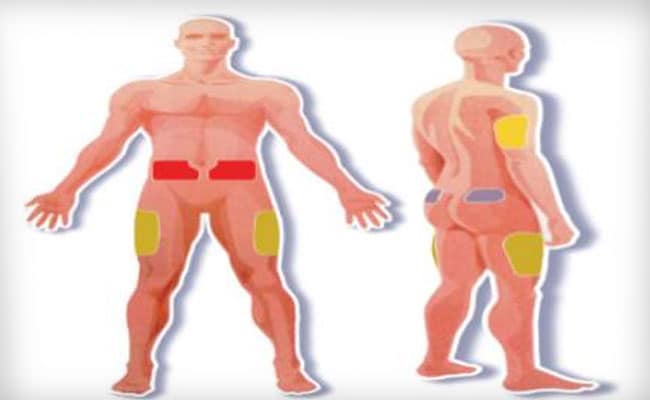
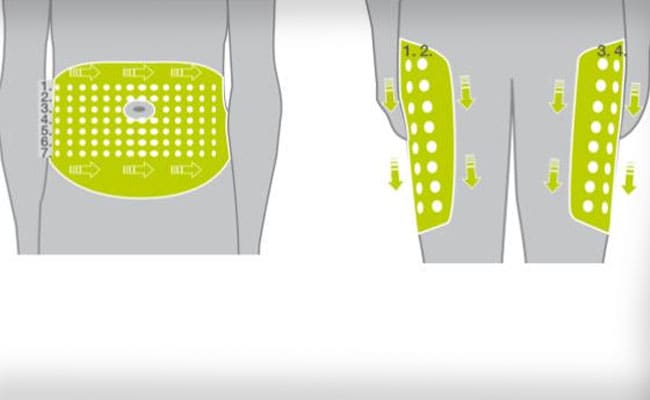
The most common injection site for insulin use in diabetics is:-
  1. The abdomen (or stomach)
  2. The back of the upper arms.
  3. The upper buttocks or hips.
  4. The outer side of the thighs.
common sites of injection

Rotating Your Injection Sites
If you inject insulin three or more times a day then it's a good idea to rotate your injection sites. Injecting in the same place much of the time can cause hard lumps or extra fat deposits to develop. These lumps are not only unsightly; they can also change the way insulin is absorbed, making it more difficult to keep your blood glucose on target.
Follow these two rules for proper site rotation:
  • Same general location at the same time each day.
  • Rotate within each injection site.
rotating your injection sites

Injection site rotation is important for both insulin syringe and pen users.
Same Time, Same General Location
Insulin is absorbed at different speeds depending on where you inject, so it's best to consistently use the same part of the body for each of your daily injections.
Fastest from the abdomen (stomach)
  • A little slower from the arms
  • Even slower from the legs
  • Slowest from the buttocks
  1. It is a good idea to inject your breakfast and lunch bolus doses into the abdomen.
  2. Your supper or bedtime dose of long-acting insulin could be injected into the thigh, buttocks, or upper arm.
  3. If you mix two types of insulin in one shot, you can inject into the abdomen, arm, thigh, or buttocks.
  4. Rotate Within an Injection Site
  5. To avoid developing hard lumps and fat deposits, it is important to inject in different spots within a general part of the body.
  6. Inject at least one finger's width from the last injection.
Smart Tips for Site Rotation
  • Do not inject close to the belly button.
  • For the same reason, do not inject close to moles or scars
  • If you inject in the upper arm, use only the outer back area (where the most fat is).
  • Move to a new injection site every week or two.
  • Rotate the sides (right, left) of your body where you inject within your injection sites.
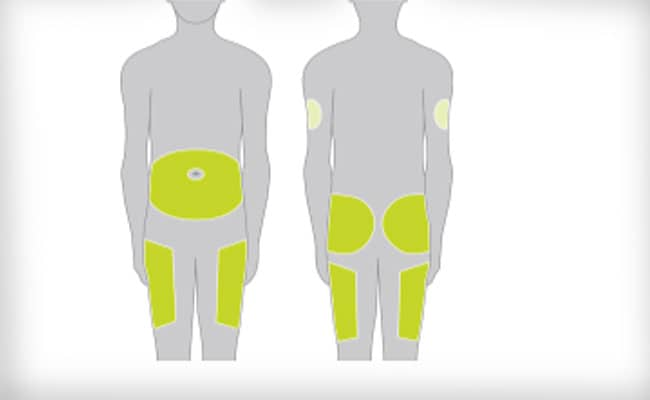
Suitable injection sites
  • Insulin is not absorbed at the same speed at all sites
  • Abdomen and thighs are the most common injection sites.
  • Injection sites on the abdomen allow rapid insulin absorption.
  • Injection sites on the thighs and buttocks allow slow insulin absorption.
  • The effect of analog insulins is less dependent on the injection site.
  • muscle as the subcutaneous fatty tissue is very thin and the injection sites are not easily accessible.
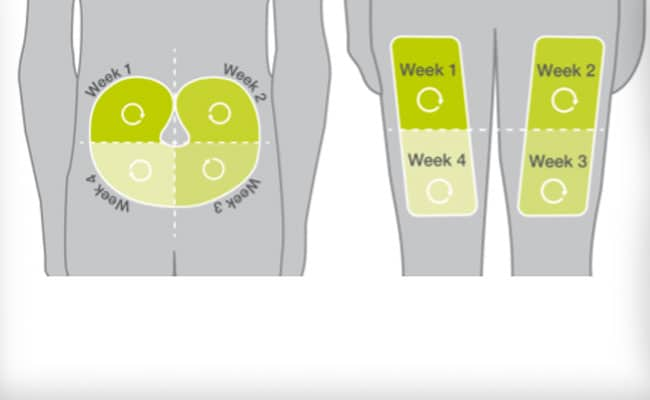
rotation principle for injection sites

Rotation principle for injection sites - Avoiding lipohypertrophy (tissue hardening)
  • Change the injection site after every injection (rotation principle).
  • The injection sites should be at least 3 cm away from the navel and apart from each other to avoid frequent injections into so-called "favourite sites" and thus leading to tissue hardening (lipohypertrophy).
Examples for the rotation principle
Example 1
examples for rotation principle

Example 2
examples for rotation principle

The correct injection technique
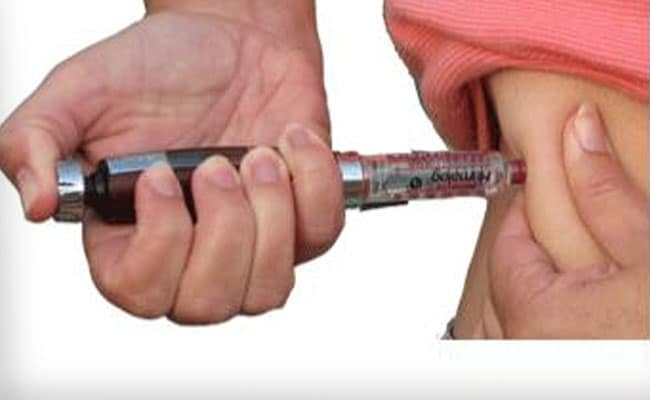
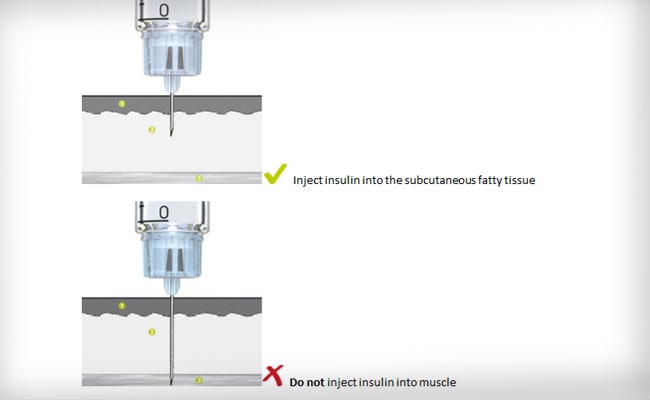
The insulin is injected into the subcutaneous fatty tissue
Skin
Subcutaneous fatty tissue
Muscle
To achieve a good insulin dose effect it is essential to inject the insulin into the subcutaneous fatty tissue (subcutaneous injection) and not into the muscle. If insulin is injected into the muscle, this can lead to severe hypoglycaemia.
Inject insulin into the subcutaneous fatty tissue
Do not inject insulin into muscle

correct injection technique

The correct needle length and injection technique is crucial for correct injection
  • Injections with ultra short pen needles (4 and 6 mm) provide reliable insulin delivery into the subcutaneous fatty tissue (subcutaneous injection).
  • The correct needle length is crucial and is determined in consultation with your physician at the start of pen therapy.
  • The choice of injection technique together with the right needle length can avoid injection into the muscle.
As a rule, the following needle lengths are recommended:
  • Children and adolescents-4 or 6 mm needle length
  • Adults-4, 6 or 8 mm needle length. In general, therapy tends to be started with the shorter pen needles.
The correct injection technique for different needle lengths
For 4 mm needle length
Hold the needle vertically at an angle of 90 degrees, without creating skin fold (for some children, very slim adults and when injecting into the thigh, forming of a skin fold may prove necessary).
For 6 mm and 8 mm needle length
Injection at an angle of 90 degrees with a skin fold or 45 degrees without a skin fold.
Correct forming of a skin fold
  • Create the skin fold using thumb and index finger (possibly also using middle finger).
  • Keep skin fold loose and relaxed. Do not press together hard, resulting in pain or turning the skin white.
  • If all fingers are used, there is a risk of also including the muscle. This can lead to an undesired intramuscular injection.
Single use pen needles
Multiple use of the pen needle can lead to the following risks:
  • The needle is already somewhat blunted after single use, the lubricant film can show signs of wear and the tip of the needle can be deformed:
  • Injections become more painful.
  • This can lead to small injuries or bruising.
  • The pen needle is no longer sterile after initial use:
  • Re-use is not hygienic.
  • Increased risk of infections.
Insulin can crystallise in the pen needle:
  • The pen needle may become clogged and a safe insulin injection is therefore no longer guaranteed.
  • This can lead to dosage errors and unexpectedly high blood glucose levels.
Presence or increase in size of air bubbles in the cartridge:
  • Insulin may drip out of pen needle (during storage).
  • Insulin dose becomes inaccurate.
Storing insulin 
  • Spare insulin should be kept in the fridge at between 4 C and 8 C , Pen in use should be maintained between 8-25 degrees celsius
  • Cold insulin may take longer to absorb and cause stinging. Give the insulin at least half-an-hour at room temperature before injecting
  • Insulin can be stored in earthen pot (on sand) in cold and dry place away from sun light even in a hot condition
  • The insulin device or cartridge in use can be kept at normal room temperature for one month
  • Keep insulin away from children
  • Always check the expiry date